Versions and Types This page compares different Bible translation types (word for word, thought for thought, paraphrase), translations (NIV, King James, NASB, NRSV, Living Bible, The Promise, The Message, Amplified Bible, etc.) and Bible types (Study Bible, Parallel Bible, Reference Bible, Chronological Bible, etc.). Also looks at the development of our modern English Bibles from the ancient manuscripts. One section has examples of the same passage as it appears in several different translations. |

|
Some of the text material on this web page is available as a downloadable PDF file so you can print it. Click here.
The chart a little way down can also be downloaded as a printable GIF file; just right click your mouse on it.
Languages of the Bible
Obviously, the Bible was not originally written in English, Italian or any modern language. The Old Testament was written primarily in Hebrew with small parts being written in Aramaic. However, while Jesus most likely spoke Aramaic, the New Testament was originally written in Greek. Thus, all modern Bibles are translations of the original languages.
Methods of Translation
- Literal translation. Attempts to keep the exact words and phrases of the original. It is faithful to the original text, but sometimes hard to understand. Keeps a constant historical distance. Examples: King James Version (KJV), New American Standard Bible (NASB).
- Dynamic equivalent (thought for thought) translation. Attempts to keep a constant historical distance with regard to history and facts, but updates the writing style and grammar. Examples: New International Version (NIV), Revised English Bible (REB).
- Free translation (paraphrase). Translates the ideas from the original text but without being constrained by the original words or language. Seeks to eliminate historical distance. Readable, but possibly not precise. Examples: The Living Bible (TLB), The Message.
Most translations are available in several different types of Bible. Here are just a few of the many different kinds of Bibles.
- Traditional. Text only. Minimal footnotes.
- Study Bible. Such Bibles usually have extensive footnotes and explanatory notes next to the columns of text. They may also have extensive cross references, a narrative commentary, and maps. (Some also have a cyclopedic index and/or a concordance—see Reference Bible.)
- Reference Bible. Usually has a cyclopedic index (like an encyclopedia with a reference to the verse where the word or thought is used), a concordance (like a dictionary of common words with examples of their usage and verse references for each example), and maps.
- "Place in Life" Bible. Has meditations and thoughts about issues of concern to people at a particular stage in life. There are versions of these Bibles aimed at men, women, sports players, recovering addicts, new believers, converted Jews, small group members, and many others.
- One-Year Bibles. Divided into 365 readings for each day of the year, usually with each having a portion of the Old Testament, New Testament, Psalms, and Proverbs.
- Chronological Bible. Entire Bible in one continuous story with narration to cover gaps and make everything flow. The four gospels are harmonized into one, for example, and the writings of the prophets are placed in the proper historical place in the books of history.
- Pastor's Bible. Includes protocol outlines and recommended verses for hospital visits, weddings, funerals, and other events. Often has answers to frequently asked questions.
- Children's Bible. Usually includes color drawings, maps, and simplified stories.
- Parallel Bible. Has from two to eight translations side by side.
- Other Specialty Bibles. The Serendipity Bible, The Quest, Key Word Bible, Leadership Bible, Hebrew-Greek Keyword Bible, "Here's Hope" Bible, Serenity Bible, and many others.

Get more than one Bible. For your main reading and study, use a dynamic equivalent translation (strikes a balance between literal and paraphrase). Get one that draws upon newly-discovered sources (after 1966). The most widely used Bible today in the U.S. is the New International Version (NIV), which is a good choice. Select a type with good explanations, either a Study Bible or a Student Bible. Then augment it with two or thee others such as a freer translation such as the New Living Translation (NLT) or "The Promise" (CEV) and a word-for-word translation such as the English Standard Version (ESV).
Original Manuscript to Modern English Bible
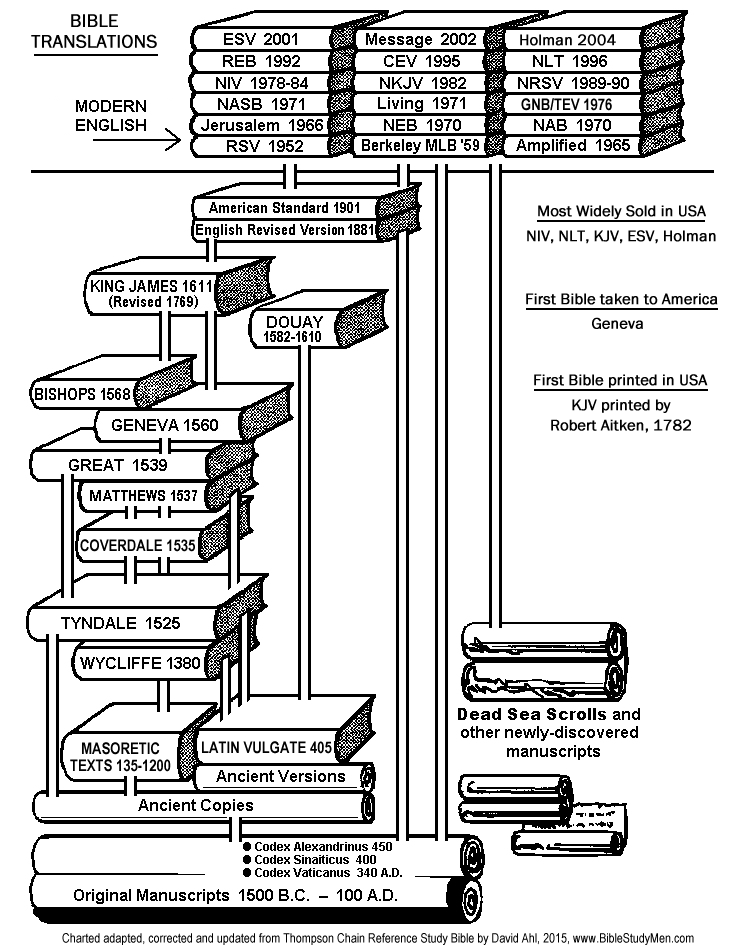
Comparison of Major Bible Translations
| Word for Word Translation | Reading Level |
Year Published and Description |
| Interlinear | 12 + | The original Masoretic (Jewish) text in Hebrew and Greek. English translations available. Very difficult to read and understand. Need a concordance. |
| New American Standard (NASB) | 11.0 | 1971, updated 1995. A revision of the American Standard Version of 1901. Formal modern English; somewhat difficult but more readable than KJV. |
| Amplified | 11.0 | 1965. Modern English version from original Greek text. Has bracketed words and phrases to help explain more difficult and complicated passages. |
| English Standard Version (ESV) | 8.0 | 2001. A literal translation that makes use of recently discovered sources. Easier reading than other word for word translations. |
| Modern English Version (MEV) | 10.0 | 2014. Formal equivalence update of the King James Version (KJV), re-translated from the Masoretic Text and the Textus Receptus. |
| King James Version (KJV) | 12.0 | 1611. Draws heavily on the Bishops Bible (1568) and also on the Geneva Bible (1560). Difficult to read and understand due to 17th Century vocabulary and style. Uses no original or recently discovered sources. |
| New King James Version (NKJV) | 9.0 | 1982. Taken directly from KJV but with more modern words. Choppy reading because it maintains 17th Century sentence structure. |
| Revised Standard Version (RSV) | 8.7 | 1952. A revision of the ASV of 1901. Further revision to New Testament in 1971. Widely accepted by both Protestant and Roman Catholic churches. |
| Holman Christian Standard (HCSV) | 8.5 | 2004. Highly readable, accurate translation in modern English. Good balance between word-for-word and thought-for-thought leans toward word-for-word. |
| Thought for Thought | also sometimes called Dynamic Equivalence | |
| New Revised Standard Version (NRSV) | 10.4 | 1990. Revision of RSV, still literal, but moves in the thought-for-thought direction. Language not updated but tends to gender neutrality and political correctness. |
| New American Bible (NAB) | 6.6 | 1970 with updates to 1991. Clear, straightforward translation from the Greek. The first Roman Catholic Bible in modern American English. |
| New Jerusalem Bible (NJB) | 7.4 | 1986. Revision of Jerusalem Bible (1966). Roman Catholic. Highly readable modern translation. |
| New International Version (NIV) | 7.8 | 1978-84. Completely new translation from oldest and best Hebrew, Greek, and Aramaic sources. Accurate, smooth reading version in modern English. Widely accepted by most churches in USA. Today’s NIV (TNIV, 2005) and revised NIV (2011) are gender neutral versions of NIV. |
| Revised English Bible (REB) | 7.5 | 1989. Revision of New English Bible (1970). More “literary” than NIV, more dynamic equivalence. Highly readable. Widely accepted by churches in UK. |
| New Century Version (NCV) | 5.0 | 1987. Revision of International Children’s Bible aimed at young readers and those with low reading skills. Gender neutral version published 1991. |
| New Living Translation (NLT) | 6.3 | 1996, updated 2004. Converts of paraphrased Living Bible to a thought-for-thought translation. Highly readable in vocabulary and language. Gender neutral. Does not use original or recently discovered sources. |
| New Int'l Readers Version (NIrV) | 2.9 | 1996. Revision of NIV for early and ESL readers. Uses simple short words and sentences. Complex meanings sometimes lost. |
| Good News Bible (GNB) formerly Today's English Version (TEV) | 6.0 | 1976. Faithful translation draws on Greek, Hebrew and Aramaic sources. Very simple, readable version without jargon. Uses limited vocabulary. |
| Common English Bible (CEB) | ? | 2011. Fresh translation is highly readable but sickeningly politically correct and gender neutral. For example, “Son of Man” is translated as “human.” |
| Contemporary English Version (CEV) aka "The Promise" | 5.4 | 1995. Clear, simple English but with a mature style. Suitable for both children and adults. |
| Paraphrase Translation | ||
| The Living Bible (TLB or LB) | 6.3 | 1971. Paraphrase translation by Kenneth Taylor largely based on ASV of 1901. Modern language is very easy to read and understand. Also a Catholic version. |
| The Message | 4.8 | 1991-2002. Paraphrase translation by Eugene Peterson using 1980s American idioms. Easy to read but heavily criticized for scriptural deviations, altered meanings, informality, and lack of precision. |
Examples of Different Translations and Changes Over Time
Below, I've reprinted six sections of Scripture as they appear in several different versions of the Bible. Note that the Interlinear (Masoretic texts) and even the literal word-for-word King James translations are often difficult to understand today. On the other hand you may feel that some of the modern thought-for-thought and paraphrase translations like The Message are almost too free and stray too far from the original text. You may also realize after reading these translations that sometimes you need the help of footnotes, a study Bible, or a commentary to really understand a passage.
Changes in Bible Translations Over Time ~ Exodus 4:24-26
And it came to pass by the way in the inn, that the Lord met him and sought to kill him. Then Zipporah took a sharp stone and cut off the foreskin of her son, and cast it at his feet, and said, "Surely a bloody husband art thou to me." So he let him go: then she said, "A bloody husband thou art, because of the circumcision." (KJV)
At a lodging place on the way, the Lord met Moses and was about to kill him. But Zipporah took a flint knife, cut off her son's foreskin and touched Moses' feet with it. "Surely you are a bridegroom of blood to me," she said. So the Lord left him alone. (At that time she said "bridegroom of blood," referring to the circumcision.) (NIV)
As Moses and his family were traveling along and stopped for the night, Jehovah appeared to Moses and threatened to kill him. Then Zipporah, his wife, took a flint knife and cut off the foreskin of her young son's penis, and threw it against Moses' feet, remarking disgustedly, "What a blood-smeared husband you've turned out to be!" Then God let him alone. (LB)
One night while Moses was in camp, The Lord was about to kill him. But Zipporah circumcised her son with a flint knife. She touched his legs with the skin she had cut off and said, "My dear son, this blood will protect you." So the Lord did not harm Moses. Then Zipporah said, "Yes, my dear, you are safe because of this circumcision." (CEV)
Explanation (from a Study Bible): God was about to kill Moses because Moses had not circumcised his son as required by Jewish law. As he had spent most of his life in Pharaoh's palace and had married Zipporah, a Midianite, they were probably not familiar with God's laws. But Moses could not serve as a deliverer of God's people if he did not obey God's laws. Under Old Testament law, failing to circumcise your son was to remove yourself and your family from God's blessings. Zipporah was probably the one who influenced Moses not to circumcise their son, so she was required to do it to save both her husband and son; thus her pointed comment to Moses.
Changes in Bible Translations Over Time ~ Acts 13:35-39
Wherefore he saith also in another psalm, Thou shalt not suffer thine Holy One to see corruption. For David, after he had served his own generation by the will of God, fell on sleep, and was laid unto his fathers, and saw corruption.
Be it known unto you, therefore, men and brethern, that through this man is preached unto you the forgiveness of sins; and by him all that believe are justified from all things, from which ye could not have been justified by the law of Moses. (KJV)
So it is stated elsewhere, "You will not let your Holy One see decay."
For when David had served God's purpose in his own generation, he fell asleep; he was buried with his fathers and his body decayed. But the one whom God raised from the dead did not see decay.
Therefore, my brothers, I want you to know that through Jesus the forgiveness of sins is proclaimed to you. Through him, everyone who believes is justified from everything you could not be justified from by the law of Moses. (NIV)
And in another psalm it says, "God will never let the body of his Holy One decay."
When David was alive, he obeyed God. Then, after he died, he was buried in the family grave, and his body decayed. But God raised Jesus from the dead, and his body did not decay.
My friends, the message is that Jesus can forgive your sins! The Law of Moses could not set you free from all your sins. But everyone who has faith in Jesus is set free. (CEV)
So also the psalmist's prayer: "You'll never let your Holy One see death's rot and decay."
David, of course, having completed the work God set out for him, has been in the grave, dust and ashes, a long time now. But the One God raised up—no dust and ashes for him! I want you to know, my very dear friends, this it is on account of this resurrected Jesus that the forgiveness of your sins can be promised. He accomplishes, in those who believe, everything that the Law of Moses could never make good on. But everyone who believes in this raised-up Jesus is declared good and right and whole before God. (The Message)
Changes in Bible Translations Over Time ~ Proverbs 14:23, 16:26, and 18:17
In all labor there is profit. But the talk of lips tendeth only penury.
He that laboreth laboreth for himself; for his mouth craveth it of him.
He that is first in his own cause seemeth just; but his neighbor cometh and searcheth him. (KJV)
 In all labor there is profit,
but mere talk leads only to poverty.
A worker's appetite works for him,
for his hunger urges him on.
The first to plead his case seems just until another comes and examines him. (NASB)
All hard work brings a profit,
But mere talk leads only to poverty.
The laborer's appetite works for him,
His hunger drives him on.
The first to present his case seems right,
Till another comes forward and questions him. (NIV)
Work brings profit; talk brings poverty!
Hunger is good—if it makes you work to satisfy it!
Any story sounds true until someone tells the other side and sets the record straight! (LB)
Hard work is worthwhile,
But empty talk will make you poor.
The hungrier you are, the harder you work.
You may think you have won your case in court,
Until your opponent speaks. (CEV)
Hard work always pays off,
Mere talk puts no bread on the table.
Appetite is an incentive to work;
Hunger makes you work all the harder.
The first speech in a court case is always convincing
—until the cross-examination starts.
(The Message)
Changes in Bible Translations through Time ~ Proverbs 18:24
Original Masoretic Hebrew (English translation from the Interlinear Bible)
A man [who has] friends must show himself friendly and there is a friend [that] sticks closer than a brother.
(There are two ideas here: 1. To have friends, you must be a friend and 2. One friend may be closer than a brother. Over time, translations deviate further and further from these original two ideas.)
Wycliffe Bible (1395)
A man freendli to felouschipe schal more be a frend, than a brothir.
(A man friendly in fellowship shall be more a friend than a brother.)
Tyndale (1525) and Coverdale Bible (1535)
A frende that delyteth in loue, doth a man more fredshipe, and sticketh faster vnto him then a brother.
(A friend that believes in love does a man more friendship and sticks closer to him than a brother.)
Geneva Bible (1560)
A man that hath friends, ought to shew himselfe friendly: for a friend is neerer then a brother.
Douay-Rheims Bible (1582, from the Latin Vulgate. Revised 1750)
A man amiable in society, shall be more friendly than a brother.
(A modernized version of the Latin Vulgate, which was quite inaccurate on this verse.)
King James Version (1611, revised 1769)
A man that hath friends must shew himself friendly: and there is a friend that sticketh closer than a brother.
Major shift in meaning and emphasis of the translations at this point.
English Revised Version (1881), American Standard Version (1901)
He that maketh many friends doeth it to his own destruction: but there is a friend that sticketh closer than a brother.
Revised Standard Version (1952)
There are friends who pretend to be friends, but there is a friend who sticks closer than a brother.
New American Standard Bible (1971)
A man of too many friends comes to ruin, But there is a friend who sticks closer than a brother.
Living Bible (1971) Paraphrase translation by Kenneth N. Taylor.
There are “friends” who pretend to be friends, but there is a friend who sticks closer than a brother.
New International Version (1984 version)
A man of many companions may come to ruin, but there is a friend who sticks closer than a brother.
New International Version (2011 version)
One who has unreliable friends soon comes to ruin, but there is a friend who sticks closer than a brother.
Contemporary English Version (1995)
Some friends don't help, but a true friend is closer than your own family.
The Message (2002) Paraphrase translation by Eugene Peterson
Friends come and friends go, but a true friend sticks by you like family.
(This is completely out in left field; there is no connection between this and the original concept.)
Common English Bible (2012) Gender neutral, politically correct translation
There are persons for companionship, but then there are friends who are more loyal than family.
Changes in Bible Translations through Time ~ John 12:25
Original Masoretic Hebrew (English translation from the Interlinear Bible)
The [one] loving the life of him loses it and the [one] hating the life of him in the world this to life eternal will keep it.
Tyndale (1525) and Coverdale Bible (1535)
He that loueth his life, shal lose it: and he that hateth his life in this worlde, shal kepe it vnto life euerlastinge.
King James Version (1611, revised 1769)
He that loveth his life shall lose it; and he that hateth his life in this world shall keep it unto life eternal.
New International Version (1984 version)
The man who loves his life will lose it, while the man who hates his life in this world will keep it for eternal life.
Holman Christian Standard Bible (1999)
The one who loves his life will lose it, and the one who hates his life in this world will keep it for eternal life.
(Of the modern translations, this is probably the best and most faithful to the original.)
New International Version (2011 version)
Anyone who loves their life will lose it, while anyone who hates their life in this world will keep it for eternal life.
(Bad grammar: singular and plural cases do not match in this gender-neutral translation.)
Open English Bible (2013)
A person who lives her life loses it; while someone who hates her life in the present world will preserve it for life through the ages.
(Word substitutions and changes in this politically-correct, gender-neutral version are simply horrible:
"him" becomes "her" — "Son of Man" becomes "Child of humanity" — "apostle" becomes "ambassador"
Note progression over time: One / him — He / his — The man / his — One / his — Anyone / their — A person / her
Changes in Bible Translations through Time ~ Colossians 2:9-10
Original Masoretic Hebrew (English translation from the Interlinear Bible)
For in him dwells all the fullness of the Diety bodily and you are in him complete who is the head of all rule and authority.
King James Version (1611, revised 1769)
For in him dwelleth all the fulness of the Godhead bodily. And ye are complete in him, which is the head of all principality and power:
(No reason to change "rule and authority" to "principality and power," but otherwise accurate.)
Weymouth New Testament or New Testament in Modern Speech (1903)
For it is in Christ that the fulness of God's nature dwells embodied, and in Him you are made complete, and He is the Lord of all princes and rulers.
Holman Christian Standard Bible (1999)
For the entire fullness of God's nature dwells bodily in Christ, and you have been filled by Him, who is the head over every ruler and authority.
(Probably the best balanced — word-for-word and thought-for-thought — translation of the modern ones.)
The Message (2002) Paraphrase translation by Eugene Peterson
Everything of God gets expressed in him, so you can see and hear him clearly. You don’t need a telescope, a microscope, or a horoscope to realize the fullness of Christ, and the emptiness of the universe without him. When you come to him, that fullness comes together for you, too. His power extends over everything.
(Again, way out in left field. A horoscope! Besides, Paul's original text says the fulness of God dwells in Christ and says nothing at all about you, the reader, realizing the fulness of Christ. And "rule and authority" is over-simplifed to "power" alone, which is not the same thing. This is Eugene Peterson writing his own scripture; it is not God's Word.)
New Living Testament (2004)
For in Christ lives all the fullness of God in a human body. So you also are complete through your union with Christ, who is the head over every ruler and authority.
(Of the modern translations, this thought-for-thought paraphrase captures nicely what the text is teaching.)
BIBLE STUDIES
- 19 diverse studies on various Topics of the Bible.

- The Jesus We Don't Know. Tall or short? Have a beard? Long hair? Handsome or ugly? Rich or poor?
- 15-lesson study on the 50 commands of Jesus Christ
- 26-lesson study on the 46 parables of Jesus in chronological order
- 47-lesson study on the Gospel of Luke
- 25-lesson study on 1 Corinthians
- 10-lesson study on the Book of James
- 9-lesson study on Paul's letter to the Galatians
- 6-lesson study on the Book of Daniel Chapters 1 to 6
- Single-lesson study about Reputation using the book of Philemon.
- Types and Translations (Versions) of the Holy Bible.
- Short study on Character - Integrity.
- Short study on Character - Loyalty.
- Short study on Character - Compassion.
- Short study on Character - Forgiveness.
- Short study on Character - Passion.
- Short study on Character - Patience.
- Short study on Character - The Refining Process.
- Short study on Anger and Resolving Conflicts (Matthew 18:15).
- Rate Yourself on 20 Character Traits (includes Biblical references).
- Series of Fun Bible Trivia Quizzes - 10 or 20 Questions.

- Men's Bible Study - Wednesday mornings - Morristown, NJ.

- 14 Accountability Questions for Small Men's Groups (PDF file).
- The New (Politically Correct) School Prayer.
- Human Being Recall Notice
- Agnes' Birthday - Tony Campolo in action!
- Jesus at the Beach
- Where was God on 9/11?
- Public prayer before sporting events -- or not?
- Managing Your Money. A practical approach with a Biblical foundation
- Principles of Investing. 16 down-to-earth, no-nonsense maxims.
- Good Thoughts about Life by a Veteran.
- Bargains on Bibles and Christian Books.
E-mail me, Dave Ahl, at: DaveAhlNJ@aol.com.
Thanks, and a tip of the hat!
| United We Stand! | Jokes, Funny Cats | Christian Books | Meet Dave Ahl | Cool Links | Contact Me |
| Patriotic FDCs | Humor Books | Christian Investing | Scams Explained | Bargain Bibles | Site Map |
|
|

|

|